[This page has been machine-translated.]
Concept of Omega
This chapter explains Omega's fundamental concept for managing genealogical data.
Index cards
The program allows for the initial entry and editing of previously recorded individuals on index cards . For each real person, exactly one entry is created in Omega. Individuals who appear twice or more in a family tree (so-called double ancestors and multiple ancestors) may only be entered once. The section on input fields describes which personal data can be stored in the predefined fields and free-text documents. Millions of people can be entered.
The index card for a person also lists their marriages and children.
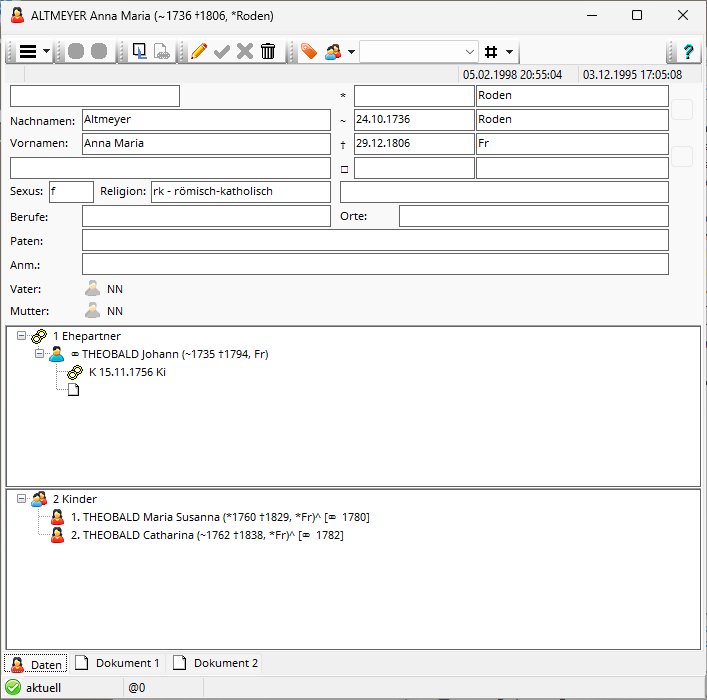
The upper field shows the individual data on Anna Maria ALTMEYER , the middle field lists the connection to her husband Johann THEOBALD , and the lower field shows the links to her two children Maria Susanna and Catharina .
Special features of places
Omega stipulates that different places should be designated with different names, while places with the same name refer to the same location. Therefore, please ensure that you distinguish between different places with the same name by using appropriate suffixes (e.g., Dillingen/Saar and Dillingen/Donau ). Links
A person is embedded in their family environment by listing their parents, spouse, and children. The following diagram illustrates the difference between the real people with their marital and child relationships on the one hand, and the index cards and links that represent these people and their relationships on the other:
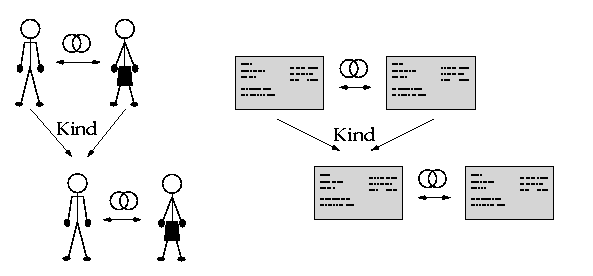
Omega allows you to include references on each index card to the index cards of up to seven spouses and up to twenty-six children of the person represented by that card. Further references are neither necessary nor possible. Connections between any index cards can be established, but can also remain open (e.g., in the case of illegitimate children, unknown spouses, etc.). In particular, Omega requires neither the entry of ancestor numbers nor user-assigned personal identification numbers. Note that the only kinship relationships explicitly entered into the program are parent-child and spouse relationships. This is sufficient to represent any kinship relationship (e.g., first cousins are represented by having their parents' parents be identical, i.e., represented by the same index cards).
In the case of double ancestors, the double ancestor has links to two children who are both ancestors.
Possible uses
This concept allows Omega to meet all requirements regarding the family relationships of the individuals being entered. To illustrate this, four examples of possible uses of Omega are given here:
- In genealogy, strictly speaking, the direct ancestors are recorded: the individual, their two parents, their four grandparents, their eight great-grandparents, and so on. The connections established are the parent-child relationships between the individual and their parents, between all their ancestors and their respective parents, and the marital relationships between the ancestors.
- In extended genealogy research, all children, including spouses and parents, and all spouses, including parents, of the subject and his/her ancestors are recorded.
- Genealogical research involves entering all descendants of a progenitor who carry on the name, along with their families. It is also possible to create records for independent branches with the same name or to compile a collection of materials related to a single name.
- Local family registers contain a multitude of families who may or may not be related. All individuals from the various families are entered, and the known connections are established.
The last two examples in particular show that any person can be entered, regardless of whether they are related to each other or not.
Directories
In Omega, data is accessed via directories. These directories are displayed in the graphical user interface as lists that you can scroll up and down. The lists of persons are of particular importance. Lists of persons are (usually alphabetically) sorted lists of people. The program generates the lists of persons.
- All persons,
- Last seen people, and
- Tagged people
automatically kept up-to-date with changes and new entries of persons. Upon user request, genealogical tables, top-line ancestor tables, research results, and lists of implausible index cards, as well as copies of personal lists sorted by criteria other than last name/first name, can be created. These user-defined tables are not continuously updated and reflect the data at the time of their creation.
Apart from the lists of persons, the following additional lists exist in a card index:
- Gazetteer
- Last name index,
- First name index, and
- Professional directory.
These are automatically kept up to date. Files
The individuals, together with their directories, form what is known as a card index . Thousands of card indexes can be created. These represent independent, self-contained units. The described concept of individuals is limited to the respective card index: no links can be established between individuals in different card indexes. If a person is to appear in another card index, they must be entered there again or copied there using Omega Transfer . The purpose of the card index system is to keep personal data separate in different card indexes according to its intended use. For example, one card index might contain one's own extended genealogical research, while another card index might contain personal data from a church register to compile a local family history book.
A file is stored on your hard drive as a set of files. Storage can be in the standard format or in a format for large data volumes. For the vast majority of users, storage in the standard format is sufficient.
Instructions on how to create a new file are provided here .