[This page has been machine-translated.]
Lineage
A paternal lineage is a generational listing of those descendants of a test subject who carry on the name. It is assumed that the children bear the father's surname or—in the case that no father has been entered (illegitimate children/children without a known father)—the mother's surname. The program does not use the surnames themselves, but solely the relationships as described above. The lineage is then generated as consecutively numbered family blocks. Who appears as a separate number in the family tree? Apart from the progenitor, the following appear in the family tree:
- every male descendant of the subject in the male lines,
- female descendants, if they have children without a known father,
- Analogous to rules 1 and 2, descendants of the children mentioned under rule 2 (these usually bear the mother's name).
Children who carry on their mother's name even though their father is known (usually illegitimate) are not considered a separate line because of Rule 2. In a maternal lineage, the listing proceeds via the female descendants. In the selection rules, men and women are then reversed.
For lineages, there is an additional parameter page in the evaluation assistant :
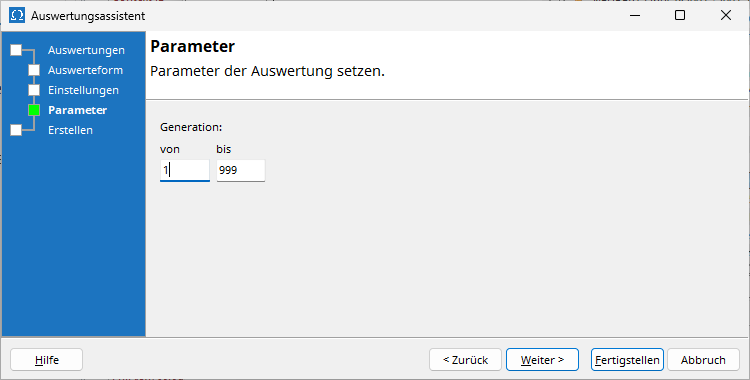
There you can configure the analysis to display only a specific number of generations up to a maximum generation number. The analysis always starts with generation 1 (subject) – this value is not adjustable.
In the Omega settings for evaluations, special settings can be made for pedigree charts in the Ancestor and Descendant Lists section. This concerns the creation of the evaluation as a paternal or maternal evaluation.
Example
As an example of creating the genealogy analysis form for a personal directory , consider a genealogically ordered analysis of families with the surname MICHAELY . The two patriarchs , Johannes MICHAELY and Friedrich MICHAELI, of the two main families are assigned the call numbers S01 and S02 . Create a new personal directory, "Patriarchs, " and add these two individuals to it. Next, copy the directory of selected index cards, sorting the copy by call number. Then, select this call number-sorted copy of the personal directory as the basis for the genealogy analysis form. The resulting analysis will contain the genealogies in the order in which you assigned call numbers to the patriarchs.